New York Luxury Bed Sleep & Hospitality
How Adjustable Beds Shape a Hotel-Inspired Sleep Setup
A hotel bed seems to understand that sleep is only one of the things we do in bed. We read, recover from long days, make room for an early coffee, and sometimes simply lie still while the city carries on outside. An adjustable base can bring that quiet flexibility home—provided its mechanics, mattress, and room are considered as carefully as the sheets.
Published November 21, 2026
The hotel-bed feeling is more than a mattress
In a good hotel room, the bed has a particular authority. It occupies the room without appearing to dominate it; its linens look considered rather than fussed over; and, after the day’s negotiations with taxis, weather, meetings, and unfamiliar streets, it offers a place to settle. The impression is one of ease. Everything seems to have been arranged so that the guest need not think too hard about what comes next.
At home, the equivalent is not necessarily a replica of a hotel suite. It is a bedroom that makes several kinds of rest feel possible. A well-made bed can be a place to sleep, certainly, but also a comfortable perch for a book, a calm setting for a slow morning, or a way to ease into the evening without sitting bolt upright against a stack of pillows. An adjustable bed base supports these different uses by changing the position of the mattress at the head, the foot, or both.
That sounds like a technical convenience. In practice, it is a small change in the character of a room. The bed becomes less like a fixed piece of furniture and more like an adaptable setting. A few degrees of elevation may help someone read without the familiar pillow rearrangement; a flatter position may suit sleep; raising the legs can provide a more relaxed posture while resting. These are comfort preferences, not medical promises, and the right position varies from person to person.
The most convincing hotel-inspired sleep setup does not draw attention to its machinery. It feels composed, works simply, and allows the sleeper to move between activities with little ceremony. The question is not whether an adjustable base is luxurious in the abstract. It is whether its flexibility makes everyday life in the bedroom more comfortable.
Begin with the way you use the bed
Before comparing controls, presets, or motors, consider the ordinary scenes that recur in your own room. Do you read in bed most nights? Watch a film there occasionally? Prefer to lie flat as soon as the lights go out? Share the bed with someone whose idea of a comfortable position differs from yours? A useful base should answer real habits, not hypothetical ones.
For a reader, independent head elevation may be the feature that matters most. It can bring the upper body into a more supported position than a tower of pillows, which tends to shift or compress during the evening. Someone who likes to relax with raised legs may value a base that adjusts the lower section as well. For others, the appeal may be less dramatic: a simple way to change posture while winding down, then return the bed to a level sleeping position.
It is also worth asking how often the adjustments are likely to be used. A sophisticated set of controls can sound appealing in a showroom, but a feature that is confusing or fiddly may become one more object to ignore. A straightforward remote, clearly marked buttons, and a smooth transition between positions are often more useful than an assortment of settings whose purpose is unclear.
Shared beds call for a little extra thought. Some adjustable systems let each side move separately, while others move the full surface together. The distinction affects not only comfort but also conversation: one person can read with the head raised while the other remains flat, or both can settle into the same position. Confirm the available configuration, mattress dimensions, and compatibility of the complete setup before making assumptions.
The base and mattress must work together
An adjustable base is only one part of the bed. Its movement depends on a mattress designed to flex with it, and not every mattress is suitable for every base. Before choosing a base, check the mattress manufacturer’s guidance on adjustability, the base’s specifications, and any conditions that could affect warranty coverage. A mattress that feels excellent on a stationary foundation may not bend or perform as intended when the platform changes position.
Consider the mattress’s construction as well as its label. Some models are specifically described as adjustable-base compatible; others may be too rigid, too thick, or otherwise unsuitable for repeated bending. Weight, flexibility, and the way layers are assembled can all matter. If you already own a mattress, verify its compatibility rather than relying on a general assumption about its material. If you are buying both components, ask the retailer or manufacturer to confirm that the exact combination is supported.
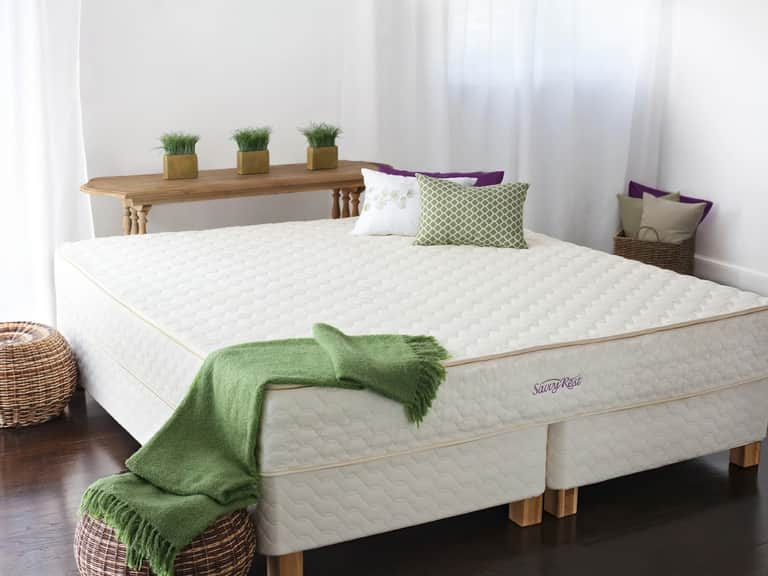
One example of a mattress that is described as compatible with an adjustable base is the Savvy Rest Serenity Latex Mattress. Its construction uses three customizable latex layers within an organic cotton casing, and the available firmness layers can be configured to suit different preferences. As with any mattress, shoppers should confirm the intended base, setup requirements, dimensions, and current warranty terms before combining it with an adjustable system. The point is not that one mattress suits everyone, but that compatibility should be established before the bed arrives.
Height matters, too. A mattress’s thickness, the base’s profile, and the height of any frame or legs combine to determine how high the finished bed sits. A bed that is too tall can feel awkward to enter; one that sits too low may make getting up less convenient. Measure the room and consider the height of the assembled surface, not just the mattress in isolation. If the base will sit inside an existing frame, make sure the frame can accommodate it and that the surrounding furniture still makes sense.
Movement should be quiet, smooth, and predictable
A bed that adjusts with a lurch or a mechanical groan may be functional, but it is unlikely to feel restful. If possible, test the base in person. Listen to its motor as the head and foot sections move; notice whether the transition is gradual; and try the controls from a normal position on the bed. A smooth movement helps the system feel like part of the room rather than a piece of equipment that has wandered in from elsewhere.
Ask how the base behaves when it starts and stops, whether it has a useful range of motion, and what happens if it loses power. Some bases include a return-to-flat function or stored positions; others keep the controls deliberately simple. Neither approach is inherently superior. The right choice depends on whether presets would genuinely save effort or whether a basic remote is all the household needs.
Practical questions deserve a place in the decision. Where will the power cord run? Is there a nearby outlet? Can the base be installed in the bedroom without difficulty? How much clearance does it require beneath or around the frame? Will the motion disturb a nightstand, rug, or nearby wall? These details are less glamorous than a description of a “zero-gravity” preset, but they determine whether the bed fits comfortably into the room.
Noise is especially noticeable at night, when the rest of the room has gone quiet. A sound that seems negligible during a busy showroom visit can feel different at midnight. If a demonstration is available, try moving through the positions in a quiet setting. Also ask about maintenance, service, and the length and scope of the warranty. Moving components make support and clear instructions worth considering alongside the initial comfort.
Make the technology disappear into the design
The hotel-inspired bedroom is not usually a catalogue of features. Its appeal comes from the way practical things recede. In a home setting, an adjustable base may be visible, hidden within a compatible frame, or incorporated into a bedroom plan that makes its presence feel intentional. The appearance depends on the base’s design and the furniture around it, so check dimensions and installation details before settling on a look.
A platform bed can offer a clean, grounded outline, but an adjustable mechanism should not simply be assumed to fit any platform frame. Confirm that the frame and base are intended to work together. Some setups use the adjustable base on its own; others are designed to place it inside a surrounding frame. The manufacturer’s directions should guide the choice, since fit affects stability, clearance, and movement.
When the bed is raised at the head, pillows and covers can shift. A neat, layered arrangement should still work in the positions you expect to use. Consider how the duvet drapes when the foot of the mattress rises, whether the sheets remain secure, and whether the pillows stay comfortably placed when the head moves. Fitted sheets need sufficient depth and a snug fit, while a duvet should offer enough coverage without becoming cumbersome. The goal is not to make every position look staged, but to ensure that the bed remains inviting and usable.
Keep the room around it measured. A pair of bedside tables, a lamp that can be reached from a reclined position, and a clear route to the door often contribute more to comfort than another layer of decoration. If the base has a remote, give it a reliable place to live rather than allowing it to disappear among books and chargers. A restrained arrangement supports the sense of order associated with a well-run hotel room, without requiring the bedroom to feel impersonal.
Bedding still does its quiet work
Adjustability changes the position of the bed, not the importance of what lies on top of it. Sheets, pillows, and a comforter remain central to the way the room feels. The pleasure of a hotel bed is often remembered as a single impression—softness, coolness, weight, the clean fall of a cover—but that impression is made from materials and layers working together.
Begin with the climate of the room and your own preferences. A crisp cotton percale has a different hand from a smooth sateen; a light cover behaves differently from a lofty winter comforter. Neither a high thread count nor an expensive fiber guarantees comfort by itself. Fabric construction, care, and personal temperature preference matter. The best bedding is the bedding that feels good night after night and can be maintained without turning laundry into an elaborate event.
On an adjustable bed, secure fit is especially useful. A fitted sheet that is too shallow may pull loose as the mattress bends; one that fits well is less likely to bunch or migrate. Pillow shape and loft also affect the experience when the head section rises. You may need fewer pillows than you use against a flat headboard, or you may prefer a small supporting pillow for reading. Try the arrangement in the position you will actually use instead of judging it only while the bed is flat.
Comforters and duvets can also respond differently when the bed moves. A heavier cover may settle toward the lower portion of an inclined mattress, while a lighter one may move less noticeably. Tucking too tightly can restrict the ease of movement or pull the bedding out of place. A relaxed, balanced arrangement tends to look more polished than one made to withstand a tug of war with the frame.
A practical route from showroom to bedroom
The process is less complicated when taken in the right order. First, identify what you want the bed to help you do: read, rest in a different position, accommodate two preferences, or simply make it easier to change posture. Next, establish whether the mattress you own—or hope to buy—is compatible with an adjustable base. Then measure the available space and check the frame, electrical access, clearance, and finished bed height.
During a demonstration, try the controls yourself. Move from flat to a reading position and back again. If you share the bed, ask to test the configuration that would serve both sleepers. Pay attention to ease of use, the sound of the motor, and how the mattress and bedding behave as the surface changes. A brief demonstration cannot tell you exactly how the bed will feel after months of use, but it can reveal whether the basic experience is intuitive.
Before ordering, get the specifications in writing: dimensions, weight limits, installation requirements, warranty terms, return arrangements, and compatibility guidance for the mattress and frame. Confirm who is responsible for setup and what happens if the system needs service. These are ordinary consumer questions, but they matter when the bed is a large, mechanically operated piece of furniture.
Finally, allow yourself time to adjust. An unfamiliar sleeping position may feel strange at first, and there is no reason to use every feature simply because it exists. Begin with a small change for reading or relaxing, then return the bed to the position that feels natural for sleep. If a setting is uncomfortable, change it. The base is there to respond to the sleeper, not the other way around.
Comfort, without the performance
Luxury is often mistaken for abundance: more controls, more settings, more fabric, more claims. But the better test is whether a room makes it easier to rest. An adjustable bed can contribute to that feeling by giving the sleeper a little more say in the shape of the evening. It can turn the bed into a comfortable place to read without a pile of pillows, or make a slow morning feel less like an appointment with the alarm clock.
It cannot, by itself, guarantee better sleep, relieve a health condition, or reproduce the service and quiet of a hotel. Sleep comfort is personal, and persistent discomfort or concerns about positioning deserve advice from a qualified health professional. A base is best understood as a flexible part of a bedroom setup, not as a treatment or a universal solution.
The most successful arrangement is usually the least theatrical. The mattress fits the base. The motor moves without fuss. The linens stay in place. A lamp is within reach, the remote is easy to find, and the room retains its calm when the bed is raised or lowered. In that small choreography of comfort, a bedroom begins to borrow something from the best hotel rooms: the feeling that rest has been anticipated, without making a spectacle of it.
That is the promise of adjustable beds at their most appealing. Not a bed that performs, but one that adapts—quietly, sensibly, and in service of the person who will spend the night there.